Though a straight line appears to be the shortest distance between 2 points, life has a way of confounding geography. Often it is the dalliances and the detours that define us. There are no maps to guide our most important searches; we must rely on hope, chance, intuition and a willingness to be surprised.

Friday, October 20, 2006

For a Change

Rather than the usual weekly update, I thought I’d post a bit of the diary I’m keeping. This isn’t a typical day for me, in fact the opposite. I hadn’t done anything like this before and it was an amazing day. Hope I’ve captured a bit of why it was so interesting.

Beautiful Corozal district

On Thursday I saw the rehabilitation side of BCVI’s work for the first time. Evan, Joan Samuels (BCVI’s rehabilitation director), Shamira (the local rehabilitation officer), and I visited families and schools in Orange Walk district who look after disabled children. I think the issues we encountered were typical of the problems and challenges, and opportunities, facing the rehabilitation staff.

The first family that we visited seemed reasonably well off by Belize standards. There were four primary school-aged children in the family, including twin girls, one of whom was blind. The children all seemed happy and a little curious about us, and in particular my laptop and camera. The blind girl kept a small bicycle with stabilizers in the house and as we sat with the parents, she brought the bike out into the living room. After a moment, she started to ride around the room, now and then making a very high pitched brrrrrrrr… noise, like a sort of alarm. Mrs Samuels told me that the child was using the echo to let her know where the walls and other obstacles were, and that she had learned to do this by herself, without any instruction. The little girl is 5 years old.
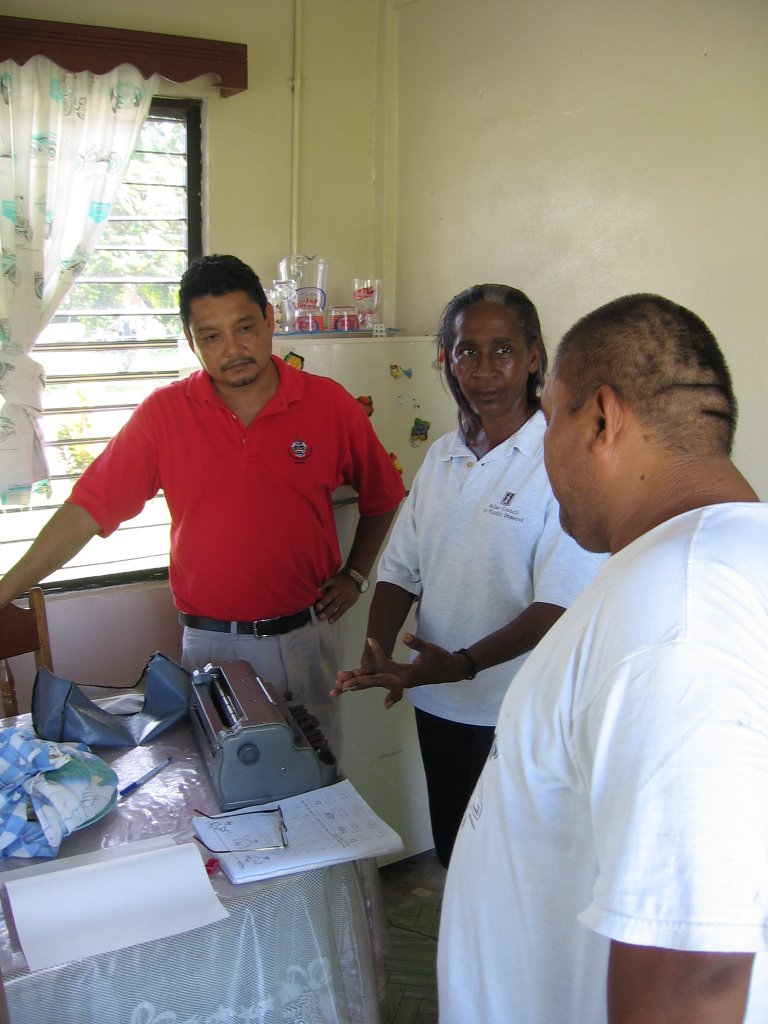
Evan downloaded some Braille instruction materials onto the father’s computer. The father was very keen to get all the information he could. In particular he wanted to be sure not only that he had the basic Braille instruction material, but also the more advanced books on mathematics and science. Mrs Samuels explained that sometimes there can be a problem if parents or teachers are too keen. The child can end up feeling overwhelmed if they are expected to do too much before they have mastered the basics of working in Braille. But seeing the father’s enthusiasm was really encouraging.


After passing on the materials and arranging a repeat visit in a few weeks, we headed off. The second family lived in a much more modest house, similarly remote from the main towns in OW district. The boy has recently left school at age 15. He is blind but has a great attitude. BCVI are planning a project that will help him earn a living by rearing pigs at the family home. We went out into the small field at the back of their house where there is a well and a pen, which seemed very cramped for the two full-sized pigs inside. BCVI hope to work out a detailed plan that will allow the boy to manage all stages of the enterprise from piglets to fully grown pigs and to build proper accommodation for them, and ensure they have food and water. The boy seemed very enthusiastic about the project, and the pigs. The pigs looked rather unenthusiastic, and ill equipped for the intense heat. Sweating and panting, they lay like beached whales, their dilated eyes staring into the heat.

Crispy Bacon

After this we visited two primary schools where we checked up on two girls with visual impairment. The first girl wore glasses but, even corrected, her vision still had limitations. We asked the headmistress how the girl was getting on. She seemed content with the girl’s progress at the school, focusing on the fact that she had ‘never complained of any problems’ in class. However, when pressed, the teacher conceded that the girl wasn’t making as much progress as her classmates, and though she never complained, this was probably more of a communication issue rather than a true reflection of the impact of her disability. Evan and I went to the classroom where Evan spoke to the girl and gave some advice to her teacher, advice which he hopes will better ensure that the girl is integrated into her classes.
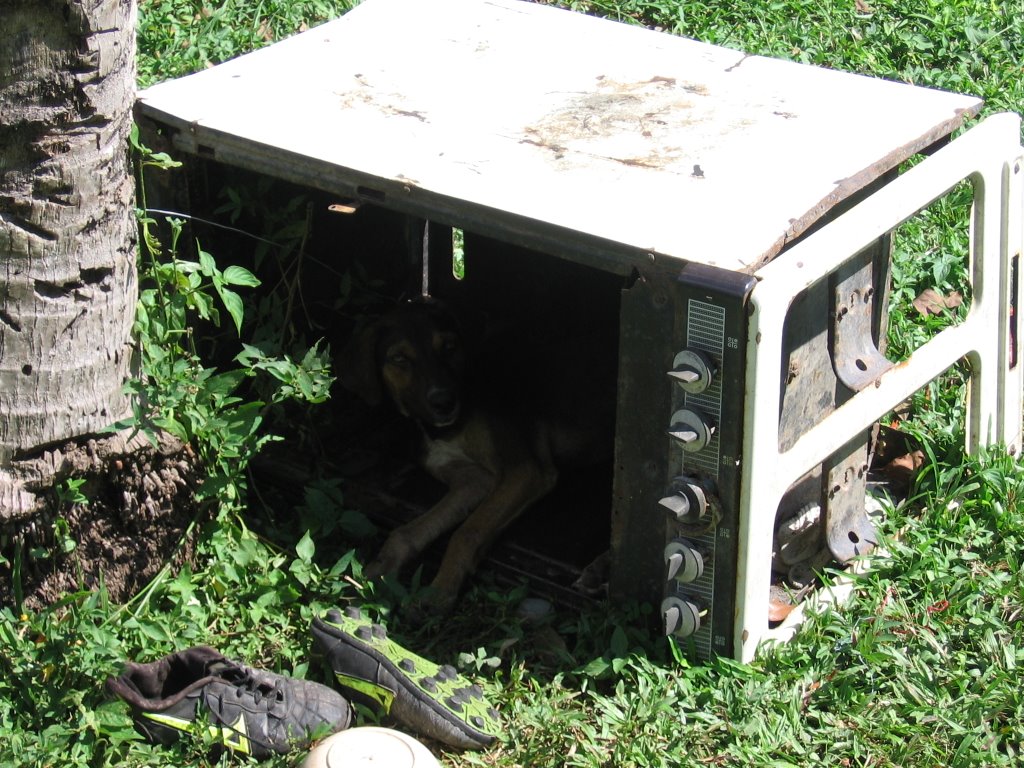
Belize in October - so hot that the dogs sleep in ovens, just to cool down

In the second school the girl was a little younger, perhaps 6 or 7, and seemed to be less keen on playing with her classmates. She was quick to get upset even when Mrs Samuels simply asked her to come over to speak to her. At the same time, the girl’s teacher seemed very keen to learn more about how she could best help the girl. Later, we spoke to the headmistress. Both teachers seemed very positive about the policy of integrating the child into school life and had few doubts or concerns, even though this was the first blind child they had had at the school. Evan again gave some words of encouragement about the benefits of integration, which is still a new policy for many schools in Belize. Mrs Samuels told me after our visit that she felt that the girl’s discomfort and anger was perhaps due to her being spoiled. I guess this must be a common temptation for parents with disabled and blind children.

Evan has the clients’ needs well covered

The third family were much more remote than the rest. We crossed into Corozal district via a hand-cranked ferry and drove for the best part of an hour on a heavily pot-holed and mud-caked road. When we got to the family home, which was very much more modest again. The mother lives there with her four young children, three of whom are disabled, one confined to bed. The other two disabled children were both playing in the kitchen and living room. They were blind and were unable to walk or support themselves.

I might have expected the children to be introverted or quiet, or to look unhappy, but they were anything but. They laughed and played and seemed completely happy and content. Mrs Samuels said they were always like that. I felt really moved to see them so happy, with so little.

Windy Miller is disappointed to find that his holiday in Belize is just like being at home

Outside, Evan showed me the wheelchairs the children had been using to get to school. The distance from the school to their house is about half a mile and the road between the two was appalling, as shown in the condition of the chairs. Both had parts missing, damaged wheels and broken footrests. I would have guessed that the wheelchairs had been shoved into this corner of the garden a long time ago, except that when I looked more closely I could see that they were in fact very new, the stitching in the back of the chairs clean and undamaged. Evan explained that the chairs were indeed nearly new but that the condition of the road was such that no wheelchair could be expected to last more than a couple of months.


It was all the more disappointing that here were two children who had a fantastic attitude and had been given the resources that they were judged to have needed, but that those resources were going to waste. Evan is determined to do something about this though. He plans to put a proposal forward to buy a golf cart for the school, which the teachers could use in the morning to collect the two children. Evan posed as I took photographs of the state of the road outside the childrens’ home. Back in the house I took photos of Evan with the children. I also took a photo of their sister who sat quite calmly the whole time, like a little angel. These photos will help Evan put together a case for funding for this project.


On the way back, we spent quite a bit of time talking about the social issues that the rehabilitation staff encounter, social problems which are all the more visceral and unavoidable for staff due to BCVI’s policy of visiting their clients in their homes rather than relying on their clients coming to the health-care centres to visit them.

In many cases, BCVI’s work seems to be hampered by the behaviour or attitude of the parents and guardians of those that they are trying to help. It could be argued that the value of BCVI intervening is called into question in a situation where the parents aren’t helping, or appear to be actively making the situation worse. Mrs Samuels was very much of the view that, regardless of the attitude of the parents, BCVI had a responsibility to the children and, unless it was impossible, they should do what they could to try to help. Where difficulties have to be lived with, they have to be lived with, and worked around. One of the biggest lessons to be learned in working in rehabilitation is that you have to provide help on the clients’ terms. It’s no good BCVI staff trying to reach a particular goal and set of outcomes that they themselves have devised. Assistance can only ever be given in a way that fits with the client’s view of what is needed and wanted, though there may be a role for BCVI to play in trying to educate parents to appreciate the benefits to the children of BCVI’s assistance.

The trip was a real education. I came away with a lot of love for the children and strong feeling for what BCVI is doing. I also have a great deal of respect for BCVI’s rehabilitation staff and their approach to working with the children.
Mangrove Swamp (not a German prog-rock group from the 70s)

Wednesday, October 18, 2006

Just for info... no need to comment.

I feel so passionately about the attached articles that I can’t help but diverge from the apolitical nature of this site. I won’t say any more, but please read if you are interested:
http://www.guardian.co.uk/commentisfree/story/0,,1920005,00.html
http://www.guardian.co.uk/commentisfree/story/0,,1924736,00.html

BTW Hope you are all cancelling your trips to Reykjavik!

Monday, October 16, 2006

Food and Drink Special

There are two things in Belize about which I could talk endlessly and induce sleep in a narcoleptic. I’ve said enough about the heat already. It’s just damn hot – that’s all there is to it. The other thing is food. Seeing as you can take photos of food and not heat, a wee update on the local tucker is in order.

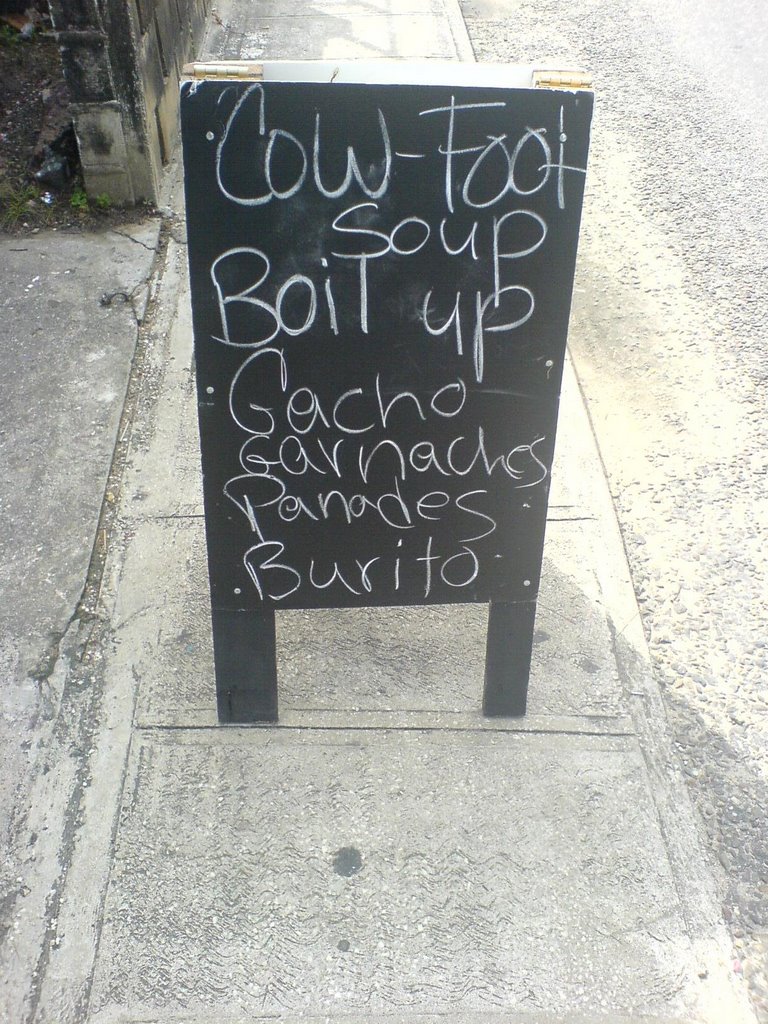
As expected, I’ve had both beans and rice, and rice and beans. But that’s only the start. The tacos are immense. I often have home-made meat pies for breakfast – also awesome. Fruit is just of a different quality altogether and portions are huge - again I'm not complaining. Drinking also seems to be a reasonably important part of the culture, with the local brew – Belikin beer – being a tasty substitute for Stella and just as strong. Rum and tequila are obviously favourites too, and of course Guinness and Red Bull.

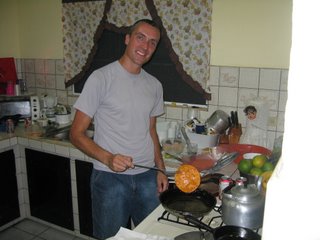
Cooking is a source of pride for a lot of people. Mari is a great cook and since she’s been away in the States, Evan, Shar and I have been trying to keep up the high standards by turning our hands to Mexican, Belizian and Italian cooking respectively.


Here I am ‘helping out’ with dinner. I am making salbutos – fried tacos with shredded chicken, shredded cabbage and salsa. This Mexican dish is a real favourite of mine, even when I cook it.

I cooked spaghetti Bolognese one Wednesday night. Before we even tasted my concoction, we celebrated the very fact that I’d cooked anything at all with a couple of Tequilas – I guess I didn’t look like I had it in me. And to accompany the spag-bol, Evan pulled an enormous fluid-filled jar of things-that-look-like-olives from a cupboard. The jar truly looked like something that had been recently recovered from the canteen of the Titanic, but the contents were pretty darned enjoyable. And the verdict on my cooking? A politely enthusiastic “well done, this is delicious”. I’ve been asked to cook again though, so it couldn’t have been that toxic.

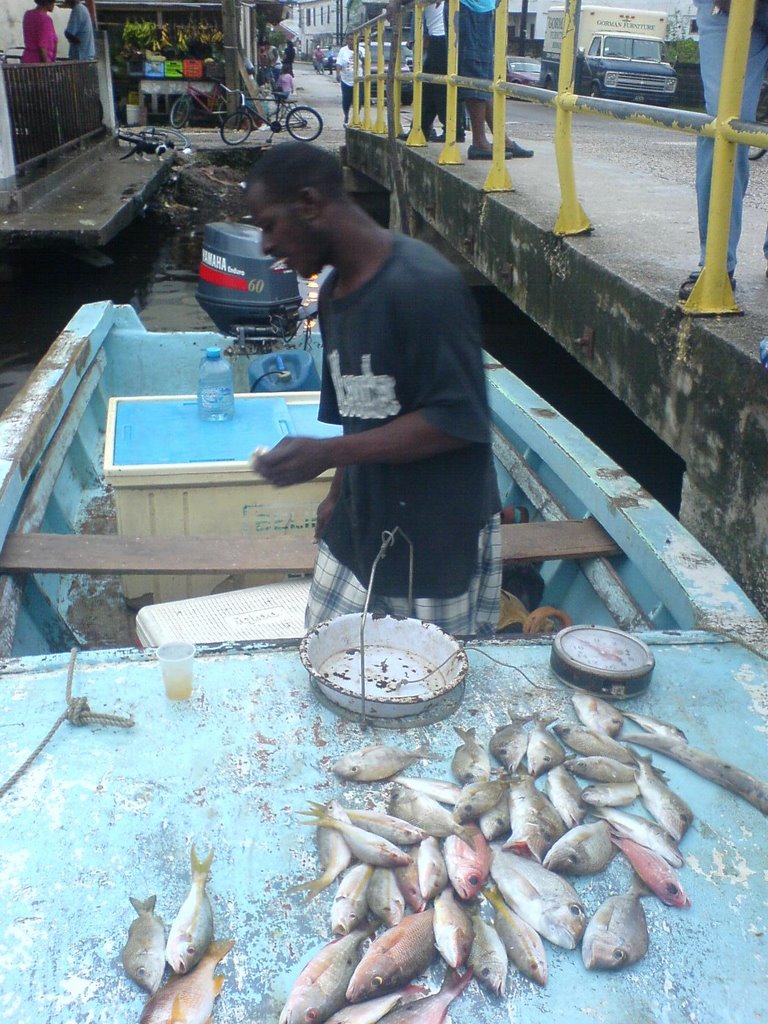
Shar made fried chicken (just like the Colonel makes it), salad and macaroni. This was also a winner. Since then we’ve been mixing things up and have had a couple of fish dishes. These require an always entertaining trip to the fish market.


The fish is chosen…


…weighed…


…then scaled,

gutted,

cleaned,

sliced

and diced.

Eating out in Belize usually means Belizian or Mexican food. In some places, while the menu is served strictly at breakfast/lunch/dinner times, you can have rice and beans at any time in between. I guess a Belizian just can’t go too long without rice and beans.

There are fancier restaurants in town, mostly congregated around the tourist hotels and catering to tourists and the rich minority in the country. Teri, a volunteer with CARE, and I have eaten out at a couple of these and can recommend Harbour View, with its… harbour view! Nice fish there, and the menu, though extortionate by Belizian standards, is still cheaper than in Edinburgh.

One thing I do miss is a nice glass of wine. Belizian wine is not of Grand Cru standards (!) and the imported wine, like everything else imported into Belize, is very expensive. So instead I have to make do with rum and coke, and of course a couple of panty-rippers:


After an unfortunate incident at the 2005 event, this popular refreshment was banned during the 2006 Twister competition (see below).

Friday, October 13, 2006

Iguana Dance With Somebody (…but I don’t wanna feel the heat)

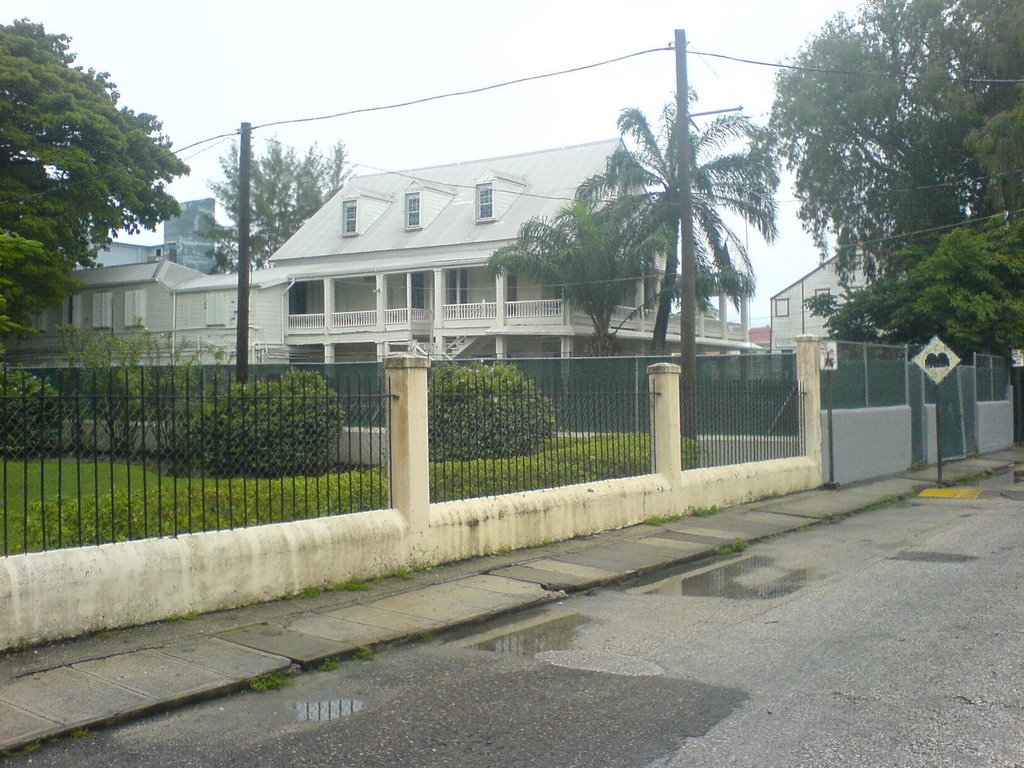
The quaint US embassy building - one of the last wooden embassy buildings - in the rain-sodden sweltering heat of BC.

I could also have gone for a musicals title this week: Fit Lizard on the Roof (ouch!). The rains here don’t come themselves but instead bring various animals sheltering from the deluge. As well as barking dogs, I now have to contend with Iguanas running around on the roof of the house. These are large (2,3, more… feet long), sharp-clawed creatures that seem to like to hold dance classes and race meetings above my bedroom between 2 and 5am.

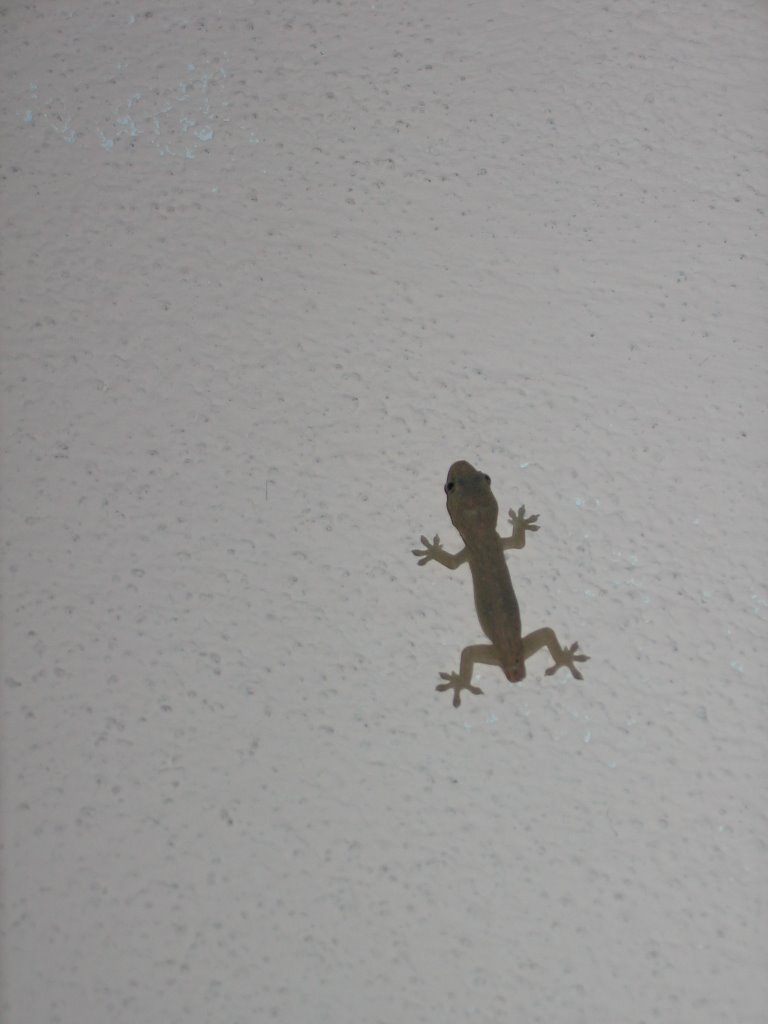
Talking of lizards, this is Steve, my roommate. Steve is a juvenile gecko. I could tell he was a juvenile just from his size. That isn’t obvious in the photo, but you were able to tell from the fact that his tail hasn’t grown yet – weren’t you? Like most of the population of Belize, Stevie can trace his ancestry back to a more distant place – China in his case. Geckos aren’t indigenous to Belize but came from Eastern parts, and perhaps as recently as 25 years ago. And their numbers have exploded in the last ten. Competing with intruders is a common problem for Belize’s wildlife and for many species it’s a battle to adapt/evolve fast enough to survive. Anyway, I’m not holding that against Steve-o, as long as he helps me in my battle against the mozzies.

So lizards at home. And the rainy season has created a bit of a ‘wildlife issue' at work too. Four of us share a smallish office at BCVI head office in Belize City. Naomi is my fellow CWW volunteer at BCVI and is working hard on the charity’s patient database, Christa (from the US) has been working as resource and promotions manager for a few months now and Mark from Belize is our long-standing IT manager.

The four of us were joined last week by a small rat. The little fellow somehow got in through the wall and streaked across the floor. After a few interesting moments, Mark and I managed to trap him in the bottom drawer of Mark's desk. I was then able to carefully pull the drawer out and carry it outside. As I 'coaxed' the rat out, Mark tried to flatten it with a broom but missed and it jumped into the drain at the side of our front door and swam away like a good ‘un. The fun didn’t end there though. As I carried the drawer back into the office, another previously unnoticed rat popped out of the drawer and skiddaddled across the office floor. We lost that one too but not before I got his photo.

So Mark and I took two rats out of the office and brought one back in. By any reasonable performance measure, I’d say that was quite a successful project. But alas, as always, the policy people in the office saw things rather differently.


Basil the rat is disappointed to find that the shapely mouse he has been eyeing up will only accept a USB connection.

I didn’t make it to Mexico last weekend because of the torrential rain but the weather is improving rapidly and plans are now in place for a deeper forage into Mexican territory - perhaps as far as Cancun – in a week or so’s time. Meanwhile, the bad weather at the weekend was a good excuse for a sustained bout of partying.


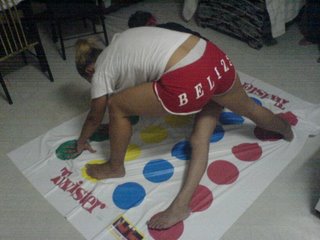
This year’s international Twister invitational is brought to you by our sponsors B E L I Z E. Here we can see a tense moment in the latter stages of the fiercely contested gold-medal bout between Sweden’s “Left-Foot-Blue” Larsson and Scotland’s “Right-Hand-Red” McKay. Columbia, the US and Scotland’s male representative were knocked out – in more ways than one – earlier in the competition.

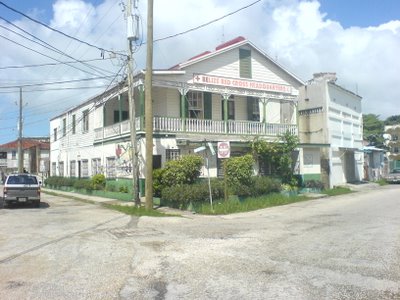
Finally, it doesn’t really lend itself to pictures but I feel like I’ve been making more great progress with the project. So I’ll finish off with a picture of where I work:

Rat’s where I work

Friday, October 06, 2006

Just Me and Maya Shadow

I had the whole of an ancient archaeological site to myself. This wouldn’t happen at Maccu Piccu.

I’ll definitely look back on this last week as the one where I really settled into life here. In some ways it’s been less eventful, but so many things have left me smiling in the last week, especially the things that haven’t gone so well.

The weather forecast predicted a monsoon for the weekend so the fishing trip was cancelled, and I think most people in Belize decided to stay home and do their washing. I wasn't in the mood for doing my washing – it’s amazing what you can get away with in a country with a good strong ‘background’ smell – so I decided to try to get to the Mayan ruins at Altun Ha instead.

Altun Ha is in the middle of nowhere, 60 miles out of Belize (a long way in this country) and 12 miles up the old northern highway, which is nothing more than a heavily pot-holed single-track road. Getting there would need a combination of buses and cadging lifts.

Buses in Belize tend to get crowded and standing in the heat can quickly become exhausting. It’s therefore a blessing that the drivers are thoughtful enough to get a good breeze going by keeping the door forced open whilst driving at motorway speeds. At the same time, it’s rather unnerving standing right in front of the door, aware that any overly enthusiastic braking would see me pitched onto the hot tarmac.

After getting off the bus it was ridiculously easy to cover the last 12 miles. People were stopping all over the place to offer me a lift. A bunch of rough looking guys were even friendly enough to let me borrow a bicycle to save me from walking the last couple of miles.

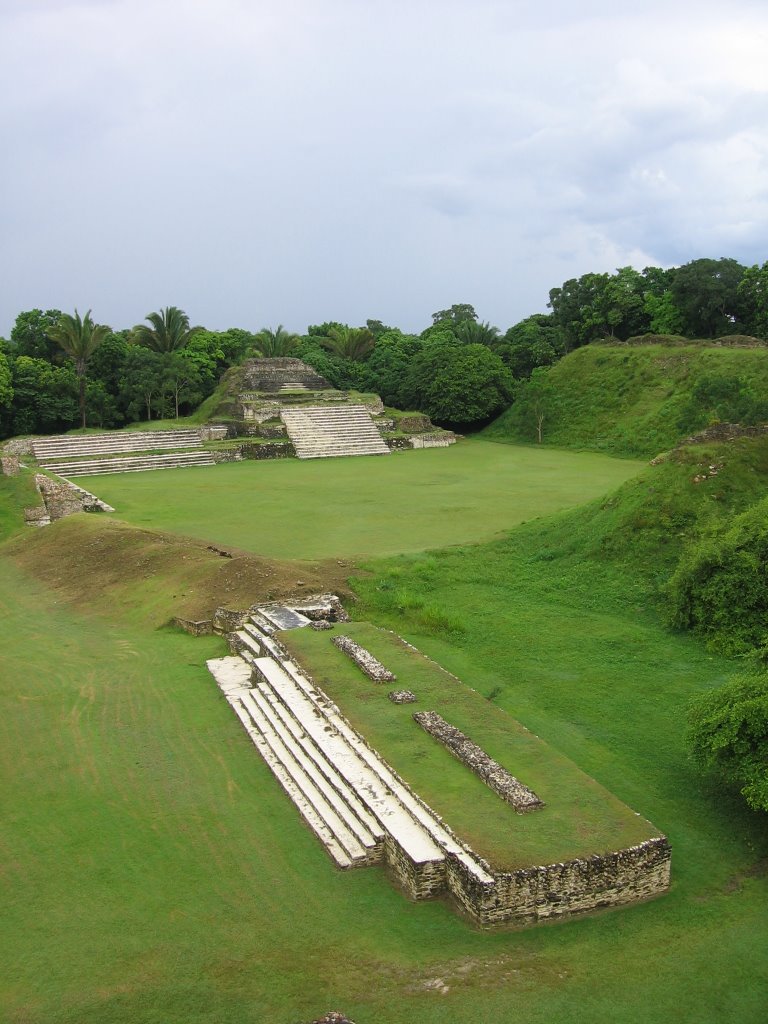
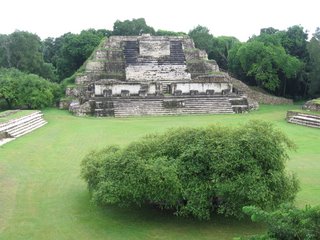
Altun Ha - one of the better preserved sites, though abandoned over a thousand years ago - was a real experience. For the two hours I was there the site was completely deserted. A bit like turning up at Stonehenge and finding you've got the place to yourself. In fact, I think I could have had most of Belize to myself, the weather report was so dire. And sure enough my luck ran out after about half an hour. At which point I discovered exactly why Belize is so fantastically green.
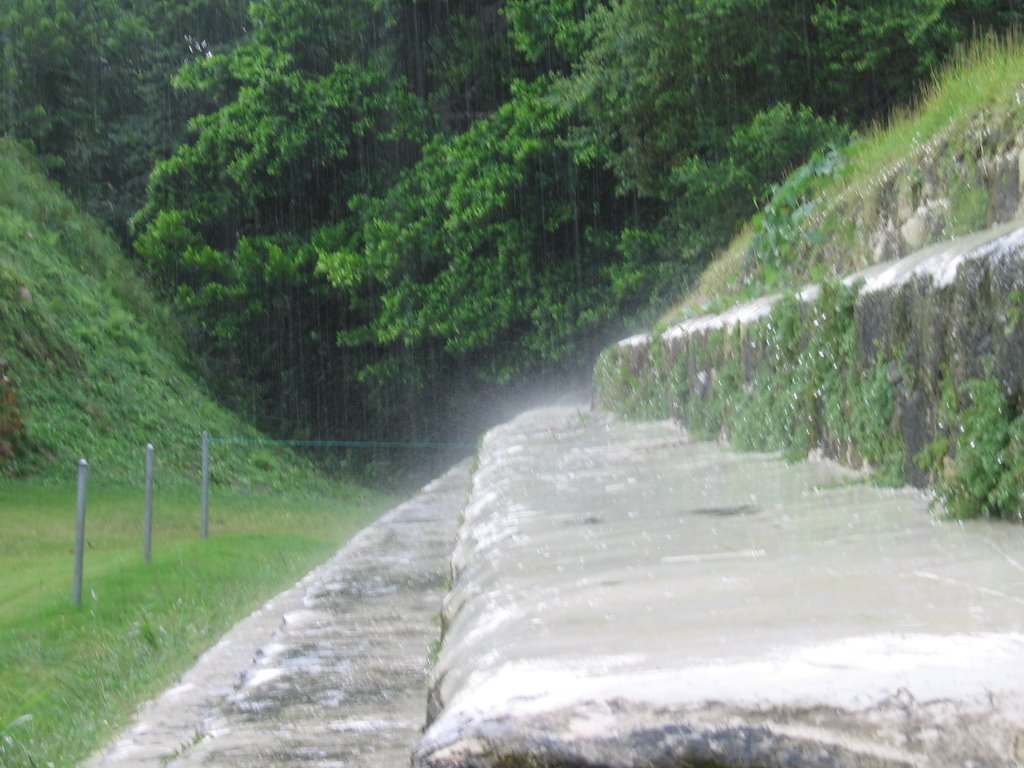
There’s a little jungle path from the site that runs three hundred yards down to a reservoir. In between sacrificing virgins and establishing a stupendously accurate calendar, the Mayans dug this reservoir to provide them with drinking water and somewhere to bathe when the rains came. And when I got to the reservoir the heavens opened.

It was as I stood, half under a tree, wondering if I should make a mad dash back to the shelter of the site and praying unhopefully for the rain to turn back from biblical to merely tropical, that I noticed a human-sized, but distinctly scaly bather in the water. Putting my specs on, I realized it was a crocodile, maybe about 100 feet away and slowly arcing towards me.
The croc is in dead centre of the pic, just above the green patch of foliage. No complaints about the picture please – it seemed menacing at the time!

In these types of scenario, you tend to root around in your brain for whatever apocryphal tale you last heard about the situation in question. I could recall some story from somewhere that went roughly along the lines that, statistically more people died from cattle running into their vehicles than from… something else. But as the croc approached, I couldn’t remember whether this was elephant stampedes, shark attacks or crocodile encounters. I could also remember that something could run faster than any man, but I couldn’t remember whether that was crocodiles, snakes or Hong Hong Phooey. Anyway, he didn’t come that close in the end, which was a little disappointing as I didn’t get a more impressive picture than the one above.

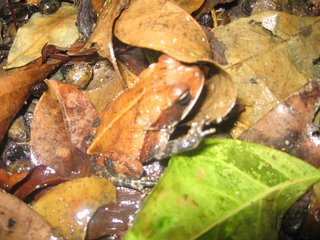
After sheltering for some time the rain had barely let up, but the narrow jungle path was becoming seriously flooded so I headed back to the ruins. About half-way along, I felt something lodge itself in my open sandals under my right toes. When I shook it out, it turned out to be this frog:
Unfortunately, as I paused to preserve a record of my amphibian hitcher, a huge fly landed on my ankle and gave me a bite large enough to leave a tiny trickle of blood on my leg.
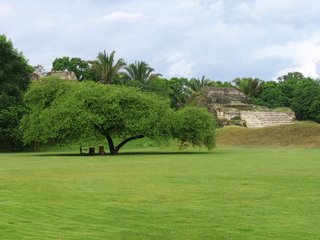
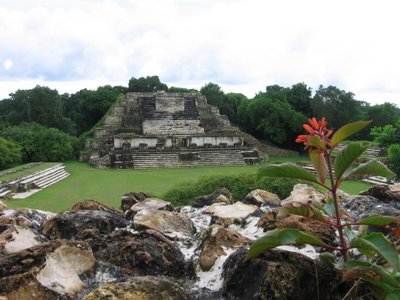
I was quite worn-out with all these wildlife encounters by the time I got back to the ruins. But at least the sun had come out, letting me get some picture postcard shots.

For me, the lesson from that day was that it’s best to accept the weather here and get on with things. I do occasionally log on to the BBC weather page for Belize City to look at the 5 day forecast. It’s not been particularly accurate so far but I’m always amazed to read the minimum night-time temperature – the prediction for each day has never been less than 26C yet. And though the rainy season is now here in full force, the heat has barely diminished. Apparently at this time of year, hurricanes forming over the Caribbean push the weather on to the land, making the humidity soar and making the changes from rain storms to clear blue skies more frequent, and less predictable. And you can still get fried if the clouds clear for even just an hour. When I logged onto the weather site on Wednesday the ‘current’ humidity level was… 98%.

Otherwise, the project continues to come along nicely. My boss has gone on four weeks holiday, but I’ve got a really good idea of what I want to do in the next month and I’m quite happy to get on with that. I’ve been traveling with work too, interviewing staff about administration/sales of glasses, here in Belize City at first, but also up north at Orange Walk. Really enjoying this part of the job – there’s so much to learn.

Going to Mexico for the holiday weekend now (Columbus Day this time). To say I’m looking forward to Mexico is putting it mildly. I’m just praying that some stranger comes up to me at some point and says “Hey, Gringo!” That would truly make my year…