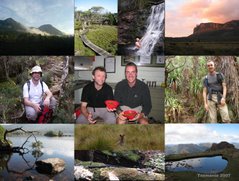
Though a straight line appears to be the shortest distance between 2 points, life has a way of confounding geography. Often it is the dalliances and the detours that define us. There are no maps to guide our most important searches; we must rely on hope, chance, intuition and a willingness to be surprised.

Monday, July 09, 2007

It Began in Afrika

(Shot of the trip???? On the morning of the second day, we did some game-spotting in the Serengeti. One ranger spotted a dead gazelle in a tree and when our landrovers arrived we spotted this leopard lying at the bottom of the tree. After a few minutes, he leapt into the tree and started devouring the gazelle. Just amazing to see these things happen. I nearly died when I saw this pic come out!)

Hey! I'm in Africa.

After a week I have so much to write about it it's just not funny. The next few updates are definitely going to be of the string of consciousness variety rather than the considered thoughtful commentary I usually like to (try to) come up with.

The internet is far too slow here and there's so much to do that any time I spend in the internet cafe is time lost when I could be seeing/doing something great.

So I arrived in Nairobi after a hellish trip from India. I was supposed to have a day to myself in Nairobi but I went straight to bed and joined the group I'm trucking round Africa with first thing in the morning.

The trip we are doing is a 54 day journey from Nairobi, Kenya to Capetown, S Africa. Some of the group have already spent 3 weeks in Kenya and Nairobi. This was the trip I was originally booked on to, and it's a bit of a shame that I missed out on trekking with the Gorillas which sounds like it must have been quite an experience.


(Meerkats in a classic pose.)

So we didn't hang about in Kenya - the first day's travel took us across the border into Tanzania where we spent two nights camping and visiting a local Masai Mara village. This was a great experience. The kids were absolutely adorable and it was great to see some genuine African village life, even though they were somewhat used to visitors.
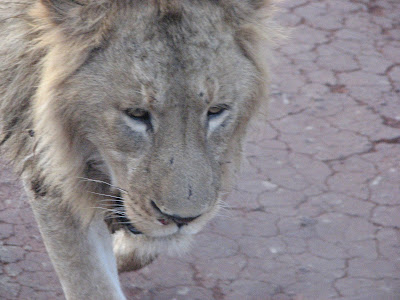
(We got incredibly close to a lion and lionness just 20 minutes into the Ngorongoro crater. What an incredible place.)

After the second night, we had an early morning start on a two-day game-park trip to the Ngorongoro Crater and the Serengeti.

I would have expected this to be one of the highlights of the African trip and wondered how it would feel to do this so early in the journey. Even on the first day in Africa - which was mostly spent on the truck the - the atmosphere felt special and Africa felt like somewhere exotic. How would a sight as famous and anticipated as the Serengeti bear-up?
(He's making tusks at me! While we were sitting at the side of a small lake having lunch an elephant appeared in the distance and slowly made its way right past us, through the edge of the lake and then walked off again. Unbelievable. At the point I took this picture, the park rangers started shouting to us to "back away from the elephant"!)

In short - it was mind-blowing! I saw... everything! Lions, lionnesses, leopard, cheetah, elephant, rhino, hippo, flamingo, zebra, giraffe, wildebeest, warthog, gazelle, ostrich, meerkats, water buffalo and quite possibly a lot of other things that I can't even remember. And most of these things we saw up close, the lions were almost close enough to reach out and touch. It was one of the best days of the year and not something that I'll ever forget.
(Lets get it o-on! This is the least explicit of a series of photos of mating lions. It's incredible how the animals just get on with things and completely ignore the landrovers. Apparently they dont perceive people in vehicles as people. But step outside of the car...)

I got some of the best pictures of the trip and have already looked over them so many times I'm worried about wearing out the buttons on my camera. I'm going to set up a flickr site and put more photos on there. I have at least twenty photos that I want to print out.

There should be more days like these over the next couple of months. We will be walking with lions at one point and swimming with elephants at another. I can't wait.


(Hangin time at the end of the day.)

Thursday, June 28, 2007

Delhi and Agro

(Qutb Minar on the outskirts of Delhi. The 73m high tower (or minar) in the background is from the 12th Century. Below left is a detail of the beautiful Islamic scroll on the minar, an extract from the Koran)

From Agra I caught the bus to Delhi. I was going to give a lengthy account of all the times people tried to con and scam me on the journey between Agra and Delhi, but I think it would get a bit tedious.

The most impressive moment came when I got to Delhi and went into a 'tourist information office' to ask directions to a hotel I'd chosen. The guy 'recommended' that I check my booking and kindly offered to phone 'someone from the hotel'. The person on the other end of the line told me that unfortunately the hotel was full and suggested perhaps I ask the guy in the office for another hotel? Hmmmmm...

Unfortunately for him, I was suspicious and when he couldn't tell me the address or phone number of 'his' hotel I left pretty sharpish.

Two weeks of travelling in India have made me alive to these kind of shenanigans. (lovely word 'shenanigans' - think it's Irish)

And that was India. I had a few slower days in Delhi before I left. I visited the national museum on my last day. The museum has a fantastic collection of stone and wood carvings. Not usually the sort of stuff that gets me excited but some of the 206,000 exhibits were absolutely beautiful.

The museum also showcases archaeological sights from all over India. I did pretty well to visit six of India's twenty-odd World Heritage Sites but still feel I barely scraped the surface. This is clearly a country where a lengthy visit is needed to see a good portion of the ancient sites.

Thoughts on India... I couldn't recommend India to anyone for a relaxing holiday. Especially when there are so many beautiful and enjoyable places to visit in the world. But if you have the time to travel round India properly and get used to the 'difficulties' there are some fabulous sights - it is definitely in a league of its own.

The last thing I did in India was to go for a haircut. My blonde 'do had gone marmalade orange about a week before - must have been the heat - and I figured a Lionel Blair cut was the only solution.

The following will be lost on anyone not familiar with BBC Scotland's Scotch & Wry.
The late, great Rikki Fulton played a barber called - I think - Malky Broon, who was quite possibly the world's filthiest hairdresser. And as I remember Tony Roper and Gregor Fischer (of Hamlet smoking combover fame) were his regular victims. My 'stylist' for the day was the Indian equivalent (he even had similar teeth).

There was a lengthy delay at the start until a 'number two' razor was found at the back of a dusty drawer. I was then extravagantly swathed in grey sheets (thank the lord the place was air-conditioned), and with much neck-twisting and some fiercesome headholds, I was trimmed to within an inch of my life.

Once all was done and much multicoloured hair was strewn across the floor, chairs and waiting patrons, my head was rubbed down with the grubbiest towel imaginable. The towel had probably been white originally, but many oil-changes later it looked in dire need of a boil wash, at least to get rid of the fried-egg stains.

On the plus side, it was probably the cheapest haircut I've had since the barber stopped using a bowl. And to think that when i was 21 I use to pay 30 pounds at the Rainbow Room in Buchanan Street.

Lastly, the monsoons have come on my last day. The local newspaper has been praying for the monsoon on behalf of its readers, even going as far to say that the weather - 36C and 80% humidity - has been 'unbearable' for locals. Spare a thought for the tourists!

Once again I'm flying off with the bad weather at my heels. I get to Nairobi tomorrow morning where the forecast is a pleasant 20C and sunny.

Tuesday, June 26, 2007

Taj Mahal and Agra

(Postcard shot - I had to get there very early to get this photo without any peeps in it. Very early!)

The Taj Mahal. Everyone's heard of it and everyone knows what it is and what it looks like. It's been called the world's greatest monument to love, and the greatest wonder of the world. And I probably need to say less about this than anything else I’ve seen in the year.


(The world's greatest monument to love)

Actually it’s maybe a rather peculiar thing to say, but there’s probably less I can say about the Taj Mahal than any of the other famous sights I’ve seen. A few things hadn't occurred to me before I visited - being a mausoleum, the interior of the Taj Mahal is very basic and uncomplicated; for the same reason, there isn’t any story around who’s lived in the building, and; given that it’s preserved in an almost and unchanged perfect state, there isn’t much to be said about the building post-construction either.

In fact, beyond the exterior of the building, there’s just not much to ‘see’.


(Ok yeah, there is a bit of a slant in this pic, but I was at a bit of a slant myself after getting up at 6am.)

But what an exterior.

The building is perfect. Even a layman like me can sit and study the Taj and see the clever, almost magical, techniques that have been used to make this possibly the greatest sights on earth*. For example, the spires, arches, doorways and windows all point upwards, making the structure look more slender than it really is. The minarets are perfectly positioned to frame the building and also add to that slender effect. (They were also built tilting out slightly so that they would collapse away from the mausoleum in the event of an earthquake.)

* Maurice Malpas lifting the Scottish Cup for Dundee United excepted, of course.

So the Taj was a real highlight. Actually, Agra itself was a great place to visit with a few other stunning sights as can be seen from the pictures below and I was happy that by chance I'd given myself three days there as opposed to the day/2-day trip advised by all the guidebooks.


The longer stay came about after another change of plan. I had thought I might just have a day in Agra and then move on to Jaipur but the difficulties of travelling round India made me knock Jaipur off the schedule. I could already write a few blogs about Indian train travel in particular. Train travel is an essential part of the Indian experience both for locals and visitors. India Rail runs no less than 14,000 trains each day, carrying an amazing 14 million passengers.

(Right: I've only left Sydney a few weeks and I'm already back on the teapots! Just beer rather than lethal cocktails this time at least. It was nice to meet a couple of Scots - Scott and Louise - in Agra. They are living and working in Osaka (the Japanese Glasgow I'm led to believe) and were in India, like me, for a couple of weeks' holiday.)

(Below left: from the rooftop of my hotel I got a great view of sunset over the Taj Mahal. And I also got a great view of local kids (and 'older kids') preparing for India's national kite-flying day.)

The journey from Amritsar to Agra was a 14 hour overnight trip. On such a long trip, it’s important to be offered more than a Scotrail cup of tea and sandwich. After just 10 minutes, four staff members had already passed by my berth offering, variously… tea, dinner, cold drinks and tomato soup. This was followed 10 minutes later by the man with the sweeties tray. Just like being at the cinema when I was a kid.

Plus, I had a bunk, which, though a little short for my 6 foot and 2 inches, was still long enough to allow some sleep. And the air conditioning was perfect.

This was all marvelous and a million miles from the soul-crushing, waking nightmare that is booking your ticket in the first place. The booking process involves a trip to the train station where you undergo a marathon of queueing (by which I mean frantic jostling) with a group of other would-be travellers (by which I mean hundreds of veteran queue-jumpers who all seem to have tenuous personal connections with the person at the front of the queue – you’d be amazed at the number of ‘friends’ I made when I was next in line to be served…) for my travel ticket (by which I mean a piece of paper bearing a vague suggestion that I might be able to board a train after reconfirming at several different and well hidden locations around the station on several different occasions).

So the trains are lovely, fabulous, great, but after arriving in Agra I really didn’t want to have to book another train journey.

Train transport isn't the only option for getting round India though. Bus travel is always another option. However, I had avoided Indian buses on the dire advice of a number of travelers who I imagined had collectively spent enough time in India to know what they were talking about.

But after a while such a volume of dire warnings had built up that I felt I must be missing out on something… probably not something pleasant, but perhaps something character building, which is after all what travel in India seems to be about.


So when I decided to make the two hour journey out of Agra to the world heritage site of Fatephur Sikri, I opted to go on the buses.


In fact, the experience wasn’t bad at all. What I will say is that the main problem is without a doubt overcrowding. In fact, overcrowding can be so severe as to be comical.


To put it another way, on my particular journey I had an opportunity to get to know several local people intimately. In fact, after the bus had taken on its full complement of passengers, I was convinced that everyone on the bus must be physically connected through bodily contact. I know that at any one point in time I was touching at least four other people - and sometimes up to 6 or 7 - with various of my limbs and other body parts.

With little chance of reading or even breathing in a relaxed or peaceful manner, I got to wondering whether a skillful and vigorous shunt of a knee could have induced the driver to steer left or right as desired, through a sort of chain reaction of involuntary body movements rippling from the back to the front of the bus.


The shots above and below are from Fatephur Sikri, a fort built by the Mughal emperor in the mid-16th century, about a hundred years before the Taj Mahal. I was just knocked-over by how much this temple reminded me of those famous drawings by M C Escher. In fact, I'd swear he must have seen these sights, or been influenced by them in some way.

All the pictures from this fort were helped hugely by the wonderful 'little fluffy clouds'-type sky on the day. The next picture makes me think of a famous picture by Magritte that hangs in the Moma in New York.


Ok, enough Tony Hart style exposition. I've now been back to India Rail's booking office and, with scratches on my back and a slightly deranged and sweaty look, I'm heading back to Delhi.

Amritsar and the Pakistan Border

After Shimla, my next destination was the golden temple at Amritsar. Though I've always thought the place looks magical, it wasn't in my original plans as it was so far from Delhi (almost on the border with Pakistan). But, with the success of my train journey to Shimla, I decided I would give it a go.

Though the train was hours late and arrived at 3am, I was still glad I'd made the journey.

The Golden Temple at Amritsar is the holiest site in the Sikh world. Sikhism began in the 15th century and is the fifth largest religion in the world. Sikhism advocates the pursuit of salvation through disciplined, personal meditation on the name and message of God, and has its roots in Northern India.

From a personal point of view, I found the Sikh temples at Amritsar to be the most relaxing place I visited in India. Hospitality is a central part of the Sikh religion. And this extends further than you might expect...

On arriving at the temple I was offered free accommodation in a building near the temple. I politely accepted and was shown to a section which is reserved for foreign tourists. The night I stayed there I even had a room to myself in the dorm-style accommodation. There was absolutely no pressure to make a donation (as a result of which I gave a bigger donation than I would have done) and I was made to feel very much at home by the Sikhs working there.

Even more exciting (for an economist) was the fact that there was a free lunch! I met two German girls in the dorm - Eva and Kiki - and we joined thousands of pilgrims at the lunch hall. In a fairly well organised scrum, we grabbed a tray, a spoon and surged with the crowd into the huge dining hall where everyone sat cross-legged in long lines on the floor. Volunteers then came round and slopped some vegetarian curry from a bucket onto our trays. This was followed by a dollop of rice and a piece of naan bread.
(The perfect hotel for when you need to give your inner-ned a holiday...)

It was a great way to get to meet some nice local people as there were very few foreigners and we were definitely objects of interest! And how was it? It was delicious! As well as which, we got offered extra naan, curry and rice. One of the best lunches I've had and an experience that still has me smiling now!

That evening, the three of us went to Wagah, Amritsar's other - and much more recent - draw. As you probably know, relations between India and Pakistan have been strained since partition in 1947. Hostilities between the two flair up from time to time (especially over the border regions) and there is always at the least an extreme 'competitiveness'. Nowhere is that better illustrated than at the border town of Wagah.


The two governments have actually built small grandstands adjacent to and on either side of the border at Wagah. Every evening soldiers on each side perform elaborate marching routines, marching up to their counterparts and making jesticulations and stamping while patriotic music blairs loudly on both sides. This was all led by a portly Indian chap of about 40, in casual gear who bore a remarkable resemblance to Peter Griffen (or Peter Griffen's black grandaddy) and marched up and down waving a giant India flag as if he'd gatecrashed the event and taken over.

I had wondered whether it would be a stage-managed and rather touristy event without much substance to it, but even though we didn't speak Hindi, it was obvious that there was more to it than that. The vast majority of the couple of thousand people there were Indian and it was clear that they took the slogan-shouting, patriotic singing and flag-waving very seriously. And from what we could see, the crowds on the Pakistani side of the border were equally in earnst.

It was quite a sobering display in the end, when you consider that both of these nations have a nuclear arsenal and have engaged in a major conflict in Kashmir within the last 10 years.

I've just finished a superb book set in northern Pakistan. Three Cups of Tea tells the story of an American mountain climber who 13 years ago started building schools for girls in the remote mountains of Pakistan. The book is a great read. It's also a textbook for how we might really resolve the 'war on terror'. The contrast between the ineffectiveness of American foreign policy in Afghanistan and the benefits of educating poor people in these remote areas is absolutely stark. And if you like that book, the similar Mountains Beyond Mountains is even better.

Footnote: As I arrived at the station to take the train from Amritsar to Agra, I asked a bloke on the platform if this was the right train. Just as I opened my mouth, i felt sure I recognised him. But, he being a portly Indian chap of about 40, that didn't seem possible. Then I recognised him as the conductor from the Wagah event! He was chuffed I'd recognised him and there followed much back-slapping and hand-pumping. That made my week!

Monday, June 18, 2007

Shimla


(Another picture from the red fort. The guy sitting down isn't a tourist - he's a guard at the Red Fort. There seemed to be a real unspoken relationship between the two which comes out in the photograph. I took loads of pictures of these two - could have kept snapping all morning)


The train from Delhi departed at 6am, arriving into Kalka at mid-day. From there, passengers transferred to the Kalka-Shimla express. This service is world famous - at least with trainspotters. The rail-line was built in the 19th century under the supervision of the British who wanted a reliable link between their new hillstation and the Indian city of Delhi.

I've had a few bizarre rail journeys on this trip - Peruvian rail's Maccu Pichu service in particular comes to mind - but nothing like this one. The train climbs almost two vertical kilometres over five hours at a maximum speed of... wait for it, 15 miles per hour.


To put that another way, Paula Radcliffe at marathon pace could just about have kept up with us the whole way (though, as we know she's not great in the heat - sorry, a bit harsh).

In fact, I've no doubt that marathon runners could have beaten us over the five hours. Aside from the limited top speed, the train was hampered by a tendency to stop for five to ten minutes at each station. After a few stops I realised that his was to give local vendors the opportunity to foist food-stuffs on the passengers and in fact, the passengers seemed only to pleased to take up the opportunities.

After a while I wondered whether the main purpose of the train was to get from A to B or just to provide a mobile picnic. And remember, this was the 'Express' service.
(Right - if this picture gives you an impression of a Sunday picnic trip rather than a serious train service, it's not misleading!)

When the train was moving - which wasn't often - one great feature was that the doors at either end of the carraige were open and you could hang out as far, and for as long and as often, as you wanted. It's often said that we've lost so much in the western world's rush to capitalism and 'modern' society.

As far as I'm concerned, the ability to hang out of moving trains is one of those things. Less facetiously, there is a serious point here - what we often now lack in the west is a sense of individual responsibilty. The 'nanny state' has robbed us of much that makes life exciting.

Overall, I loved the whole thing. Perhaps being a fan of train travel helps - I always find long-distance train trips relaxing. On this occassion I arrived both chilled out and well fed.

So... Shimla. Shimla was a hill-station established by the British in the first half of the 19th century as a 5-month-a-year retreat from the stifling heat of the Indian summer. Its hey-day was at the end of that century when for 50 years, the British ruled one-fifth of the world's population from a collection quaint colonial houses in the mountains.

Within a couple of hours of arriving it was clear to me that the place has gone steadily downhill since then (that's the problem with having a hey-day), which is ironic as I spent some considerable time going steadilly uphill to get there.

To start with the positives, the location is phenomenal - a thickly forested mountain top with dramatic valleys rolling off in a dozen different directions and snow-capped peaks in the distance. 100 years ago this must have been an awesome location for hillwalking and sheer escapism. But not now. It's hard to state how poorly the place has been developed so I'm going to borrow someone else's words:

If someone had told me that Shimla had been built by a bunch of intelligent monkeys i would have said 'what a remarkable group of monkeys, they must be shot before they can do it again.'

(Right: Shimla town planners argue over a planning application.)


And that was a hundred years ago. God knows what that guy would say now. Poorly built and stupendously ugly buildings have sprung up everywhere, spoiling every view and generating noisy traffic from which there is little escape, even on the 'pedestrianised' high street. On top of all this, most of the colonial biuldings still standing have been allowed to go to ruin.


Maybe this all sounds a bit snobbish or precious and in point of fact the place was absolutely crammed with Indian holidaymakers - this is school holiday season in India.


If you concentrate really hard, and have a sturdy pair of earplugs, it is still possible to look beyond the town itself and imagine the fantastic views without the ugliness, especially at sunset. But, when compared to hill-stations in Malaysia's Cameron Highlands, it's a real shame to see how Shimla has completely lost its charm.


I had planned to head further into the hills to McLeod Ganj, home of the Dalai Lama, but faced with a 10 hour bus journey and after the Shimla experience, I've now decided to head west, to the Golden Temple at Amritsar, just shy of the border with Pakistan.

I have a feeling this phenomenal sight will kindle my love for India.