Though a straight line appears to be the shortest distance between 2 points, life has a way of confounding geography. Often it is the dalliances and the detours that define us. There are no maps to guide our most important searches; we must rely on hope, chance, intuition and a willingness to be surprised.

Monday, June 18, 2007

Arriving in India


(I'm really pleased with this photograph. It was early morning when I arrived at Delhi's famous Red Fort. Although the fort itself isn't as impressive as some of the sites I've seen recently, it is very photogenic. In the early morning, this woman was sweeping out one of the ornately decorated buildings.)

Within two hours of arriving in Delhi, I'd completely changed my plans for India and booked a train ticket back to the Himalayas.

It wasn't so much the fact that Delhi was 38C when I arrived, but more that the news was reporting that the third stop on my original plan for India - the city of Jaipur in Rajasthan - was a full 9 degrees hotter than Delhi.

47C is no climate for a Scotsman.

At the main train station in Delhi I was able to book the last seat on the long-distance train to Shimla, 2000m higher and 20C cooler than Jaipur.

It's a great thing to be able to completely change travel plans on the spur of the moment, to swap mountain retreats for parched cities, tea plantations for Mughal palaces and relaxation and reflection for sight-seeing.

Before I left the capital, I had a day to do some exploring.

With 13 million people, Delhi is anything but quiet, but I felt more relaxed here than in Kathmandu where the traffic had seemed almost inescapable.

(Left: early morning at the mosque and someone is certainly enjoying their duties!)

Though there's enough to occupy the visitor for a couple of days, there actually aren't as many interesting sites as you might imagine for the capital city of a country with over a billion people.


I got round the old sights of the Red Fort and the main mosque in a morning, and did some shopping (a couple of nice shirts for $3) and a tour round the newer sights in the afternoon.


Candy striped tower of red sandstone and white marble at one of the largest mosques in India. Visiting a mosque is fraught with rules - no shoes, foreigners aren't allowed to climb minarets alone, don't cross in front of a praying person.

Whilst climbing the minaret, I met some lads from Kashmir who were in Delhi on holiday. Though Kashmir is a troubled area, I'd love to go there. It's quite a bit further north than Shimla though, so maybe not this time around.


Rajasthan was famous in the 18th century for astronomy. The two main observatories are in Delhi and Jaipur, with Jaipur definitely taking the honours between the two. I still hope to get to the lyrically named Jantar Mantar observatory in Japiur before I leave India, but it was still possible to get some great shots as the sun was going down on Delhi.

Sunday, June 17, 2007

Weird Things About Nepal

(Yes, this guy is wearing a Chelsea top.)

1. The looroll is too narrow (think cash receipt width). If there's one thing I thought I'd get through life without worrying about it would be the width of my toilet paper. You don't even need to think about why this would be a problem - I've solved it anyway by carrying my emergency looroll wherever I go.


2. There is a bird here in Nepal that sounds just like the alarm on my phone. I haven't seen it and I don't know what it's called but at 5am every morning and every half hour thereafter I want to strangle the damn thing. (I tried changing my alarm ring tone, but I'm still reacting to the old one. Darned birdlife.)

3. I bought a Lonely Planet Guidebook on Nepal for $4. Yes, $4 brand new, latest edition, with a $24.99 RRP. Then I got it home. The cover looks identical - glossy, coloured and with that plasticy feel. Just like the real thing. The first few colour pages inside are fine too. But then later colour pages are painted black and white, then the printing goes a bit out of line, and finally the maps at the back are very tricky to read.


If you're going to go trekking anywhere in the world with sub-standard cartography, the Himalayas probably aren't the best option.

(Then again, has anyone else wondered - like me - how you get lost coming down a mountain? Surely you just go down? Maybe moutaineering isn't for me.)

(A nun with balls)

4. My taxi driver sounded his horn 67 times on the 20 minute journey between my hotel and Nepal airport the other day. (I know because I was feeling queasy from getting up so early - why are so many flights early in the morning? - and I find it helps to concentrate on something intensely if I'm to avoid looking for Huey.) What is it with these countries and sounding horns? Some cars here actually have signs saying "Please! Sound Horn." As if anyone here needed any encouragement.


5. When I arrived in Nepal I had to adjust my watch by 4 and three-quarter hours. Yes, you have read correctly - 4 hours and 45 minutes. I knew that India was 4 and 1/2 hours ahead of GMT already without ever having heard an explanation for why. But I wasn't in Nepal more than a day before someone explained the rationale behind Nepal's unique time-zone. It's to be different from India. Nepalese are very proud about their country and determined to point up differences from India at any opportunity.

Isn't this brilliant!! I think Scotland should consider the same thing. We could change our clocks to be 17 mins ahead of GMT. Just think of the advantages - Ne'erday celebrations could start 17 minutes earlier north of the border. We would get our Nintendo Wii 2s a good quarter of an hour before our neighbours.

And now that the SNP are in power (sort-of) who better to put forward such a proposal?


(BTW Not strictly a Nepal weird thing but as I was typing this a mouse ran out from behind the monitor. I said to the guy in the cafe "there's a mouse next to my computer" and of course that's when the fun and jokes started... boom boom.)

This is a pic that Adrienne took in Kathmandu. Really like it.

Relaxing (above) just a few yards from Kathmandu's bonkers street scenes (below).

Nepal - Everest

(Mount Everest, aka Sagamartha, aka Chomalongma, aka the Big 'un.)

Back in Kathmandu the atmosphere was as pressurised and hectic as before but it was great to get round some more of the temples and also to meet other travellers - especially Anna and Laura from Italy, who are working as volunteers on childrens welfare projects in Mumbai. They had travelled by bus and train for 3 days to get to Nepal - now that's real travelling. Best of luck with the return trip guys - hope this time it is free of midnight border crossings manned by immigration officials dressed only in their underpants.

It was also great to meet up with Adrienne again, if only for 24 hours. Also, Adrienne's laid-back approach to the chaos of Kathmandu was a real eye-opener and left me wondering whether it wasn't I who needed to relax and not Kathmandu... this would be on my mind when I arrived in Delhi with thoughts of changing my travel plans.

Adrienne had only arrived one day and I was leaving the next. The flight to Delhi was the 25th of the big trip by my calculations (I really need to take up Sudoku or something) and pretty unremarkable.

The 24th flight however was something quite different - one of those once-in-a-lifetime experiences.

On the morning of my last day in Nepal, an already-jet-lagged Adrienne and I got up at 5am to catch a 6.30 flight with Buddha Air (genius) from Kathmandu to... Kathmandu.
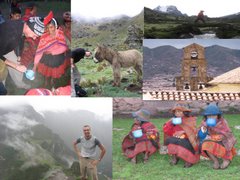
This was possibly the world's best scenic flight. In an hour we were whisked (it was a day for cliche and superlatives) to within a few miles of Mt Everest.
(Right - A very excited Adrienne waits for take-off)

What an experience.

I have always had a picture in mind of Everest and the Himalayas. In this picture, the mountains were always firmly part of the landscape. After seeing the mountains towering over the clouds, and seeming almost separate from the landscape, I will never think of them in the same way again!
(Buddha Air - I can think of so many taglines... the plane that takes you to a higher plain?)

(When can you get into the flight-deck these days? The co-pilot points out some of the highest peaks in the world, including Makalu, Lohtse and Kanchenchunga. Hope my spelling hasn't offended too many mountaineers).
(How good is this???!!!!)

(If you think this is cheesy you should have seen the t-shirts.)

Nepal - Pokhara

(Machapuchare - the fishtail mountain - pokes out of the clouds)

I was very much looking forward to visiting Pokhara. My only problem with the place was that I kept calling it Pakora, despite my best efforts not to. (when you start off down the wrong road...) I was distinctly worried that I might give the impression of intending some kind of slur against the locals.

To avoid future problems, I've crossed Kabeb and Bijha off my Indian travel itinerary.

Pokhara is a fair-sized town that serves as a base for a large volume of travellers trekking on trips into the Annapurna range. As such, it is as burdened by tourist shops, bars and 'helpful' guides as Kathmandu, but with little of the incredible temples and history.

What Pokhara does have is the best setting of any town I've stayed in on this trip. Pokhara sits on the edge of a lake surrounded by lush green hills, which are overlooked by a fantastic panorama of Himalayan peaks.

As i found out, these assets, or lack of them, make a successful trip to Pokhara pretty much entirely weather-dependent. On the first of my two days there the rain never stopped, and in fact briskly built into quite an impressive storm. At one particular moment a clap of thunder like I have never heard before - akin to a small asteroid strike, or perhaps a truck-bomb going off - exploded over the town, then rumbled on and on, reverbating round and round the valley.

The second day started slightly less bleakly than the first. Encouraged, I went for an adventurous walk into the greenery, hoping to reach the top of one of the nearby hills. Despite my initial reluctance, a local 'guide' insisted on accompanying me on the walk up the hill. After a good half hour of hiking and exchanging language tips - German for Nepali - I noticed that my new friend had stopped to fiddle with his sandals. "Leaches" he said, shaking his head more in sombre acceptance than disgust.

(Right: culture clash as Linkin Park meets traditional Nepalese arts.)


With horror I looked at my own feet. I had five leeches already attached to my right ankle and four of the little fellas enthusiastically marching up my left shoe. Though smaller than those in Tasmania, they were surprisingly determined and one managed to leave a steadily leaking hole in my right foot.
(Does this picture make you think of Barry White? When there's leeches around and the humidity is through the roof, a dip in the lake is Yak ecstacy - ohhhh yeahhhh.)

Shortly after the heavens opened again, soaking me through, but also washing the blood out of my sock and trousers (always a silver lining!).
(Pokhara crack suicide squad in heavy camouflage.)

By this point, with the thick cloud cover offering not even a glimpse of the Himalayas, I had started to wonder if I'd have been better off staying in Kathmandu where at least there were temples and museums to be visited.

Then - a miracle!

Within the space of two hours late in the afternoon the rain stopped and there were even blue skies over the valley. The mountains - if they existed - were still shrouded in thick cloud and the locals held out little hope for that cloud shifting.

So it was more in hope than in expectation that I took a taxi up to a local viewpoint, which - in good weather - was said to have a spectacular view of the Annapurnas. I, and a few others, spent the late afternoon gazing into the clouds, willing snow capped peaks to appear.
After a while it was possible to 'imagine' peaks and colls, ice-sheets and rocky slopes.

And then, just as the sun was going down, real summits and peaks peaked through the clouds.

It was a very special moment.

Without that stroke of luck and good timing, I would never have had any concept of how huge those mountains are and how incredible they look from Nepal's valleys.

The photos say it all...
(Annapurna IV - a nearly 8,000m high peak)

As a footnote, I did visit one museum when I was in Nepal, and for the love of all that is holy was it not one of the weirdest and most disturbing museums I've ever come across... If nothing else, the collection was comprehensive, with a dead body representing each of Nepal's indigenous species. Yes, I did say dead body. This was not an experience for the faint hearted - particularly the 12 foot long Python skeleton. I could have taken any number of scary pictures of the dead - and in many cases visibly still decaying - exhibits. There really was only one word for the place!

(wrong)

(wronger)

(wrongerest)

Saturday, June 16, 2007

Nepal - Kathmandu

(Local girls under the watchful eyes of the Buddha.)

Kathmandu is another of those place-names that's managed to retain some exotic feel to it, post-mass tourism, like La Paz, or Addis Ababa, or Timbuktu.
It is a very special place, dirty, dusty and incredibly noisy, but definitely, definitely unique. It was also my first introduction to Indian style poverty on the trip. I'd been to Sri Lanka before but wasn't fully ready for the onslaught of hawkers, wise-guys and scams.

It's in a different league to Belize and Bolivia.

It is possible to lose your patience and compassion when you are constantly targeted. I found myself a bit worn out, especially after my really positive experience in Cambodia.

But then I had to remind myself that more than two-thirds of Nepal's 25m population live on less than $2 per day. What would I do? With a good proportion of the tourists arriving in the country making 100 times as much, I think I'd do pretty much the same thing.
(Temples in Nepal are a mixture of Buddhist and Hindu, just as in Cambodia. The inside of some of the temples was quite earie and beautiful.)

It's the incredible disparity in incomes that's the real driver for this experience. I have been constantly reminding myself of this both in Nepal and since arriving in India. It makes me feel better and worse at the same time!
(I had the good fortune to arrive in Kathmandu the day a public demonstration by the communists was taking place in the centre of the old town.)
(Shiva and his consort Parvati look down on the residents of Kathmandu. On this occassion, they are watching a communist rally, the relevance of which would surely have escaped the original builders of the temple.)

The temples here are 400+ years old, and provide perfect grandstands for public gatherings. RIGHT: though communism in Nepal is of a religiously tolerant type, not everyone seems convinced by the political rhetoric.

As fantastic as Kathmandu is, after 2 days the noise and hassle gets a bit wearing. The car horns were getting me down, and keeping me up, until i didn't know whether I was coming or going.

I had an urge to see the snow-capped peaks of the Himalayas up close and had heard great things about Pokhara, a town sat right at the foot of the famous Annapurna range. So, on the spur of the moment, I booked a flight with the wonderfully named 'Yeti Airlines'.

There were literally a bus-full of passengers on the flight and as the bus drove away from the terminal building I imagine that every one of my fellow passengers was, like me, nervously and silently speculating on which of the jumbled assortment of small aircraft would carry us between the highest mountains in the world.

There was widespread relief when we pulled up at a modern looking turboprop plane. A relief, I didn't share as I recognised it as a Jetstream 41, an aircraft built - in part - by friends and relatives of mine at Prestwick airport...

...friends and relatives who had mentioned on a few occassions that they would never fly on them!
Obviously I arrived fine, otherwise I wouldn't be writing this. And Pokhara turned out to be a very mixed experience, but with some fantastic moments - pictures to follow!